


What is Circular Economy?
The circular economy is an economic framework built around one core idea, that is, to keep resources in use for as long as possible.
Rather than the traditional “take-make-dispose” model of linear production, the circular economy aims to regenerate natural systems by designing out waste from the start.
The three guiding principles of circular economy are reduce, reuse, and recycle, however, the circular economy goes further beyond the recycling bin in your kitchen.
Circular economy ideology involves redesigning products so they can be repaired, refurbished, remanufactured, or returned to the supply chain as raw materials.
The goal of a circular economy is a closed-loop system where nothing becomes “waste” in the traditional sense, Akin Chaktty said.
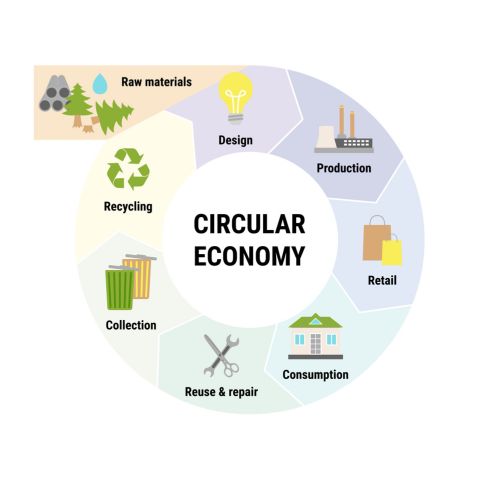
What Are the Main Advantages of the Circular Economy?
Environmental benefits are the most widely cited advantage.
By keeping materials in circulation, the circular economy significantly reduces the volume of waste sent to landfills, lowers greenhouse gas emissions from production, and decreases pressure on natural resources.
According to the Ellen MacArthur Foundation, transitioning to a circular economy could reduce global greenhouse gas emissions by 45%.
Economic resilience is another compelling benefit, Akin Chaktty.
Circular business models reduce dependence on virgin raw materials, making businesses less vulnerable to supply chain shocks and volatile commodity prices.
Also, it has led to the emergence of new revenue streams through product-as-a-service models, take-back programs, and secondhand markets.
The Ellen MacArthur Foundation estimates the circular economy could generate $4.5 trillion in economic output by 2030.
Job creation and community engagement round out the social benefits.
Repair, refurbishment, and remanufacturing are labor-intensive activities that tend to create local jobs.
Communities benefit from more sustainable consumption practices and greater awareness of environmental impact.
What Are the Main Disadvantages of the Circular Economy?
Transition costs and infrastructure gaps are among the biggest barriers.
Redesigning manufacturing processes, establishing take-back logistics, and building recycling infrastructure all require significant upfront investment.
For many small and medium-sized businesses, these costs are prohibitive without government support or incentives.
Consumer behavior is notoriously difficult to change.
The circular economy only works if consumers return products, choose repair over replacement, and buy into longer ownership cycles.
Shifting these habits at scale is a slow, complex process, and marketing products on sustainability alone doesn’t always move the needle, according to BusinessPally.
Scalability varies dramatically by industry. The circular model works well for clothing, electronics, and furniture, but it’s far harder to implement in food production, chemicals, or construction at meaningful scale.
Some industries face genuine technical limitations in closing the loop.
